Recently today, a Geekbench Benchmark of the Ryzen 5 3600 leaked.

It shows a single-core score of 5930 and a multi-core score of 26371. With this information, we can extrapolate the performance of other Zen 2 CPUs in AMD’s lineup, such as the Ryzen 7 3700X and 3800X.

First, let’s compare it to the Ryzen 5 2600, its direct predecessor. Compared to the 2600, the 3600 is about 23% faster in single-core workloads. Not too shabby. The boost is further increased for multi-core workloads, up to 28%. We now know that Lisa Su’s performance increase claim of 25% over Zen is legit.
Alright, now for the fun part. Below is a chart of the Geekbench scores of the other Zen+ CPUs.
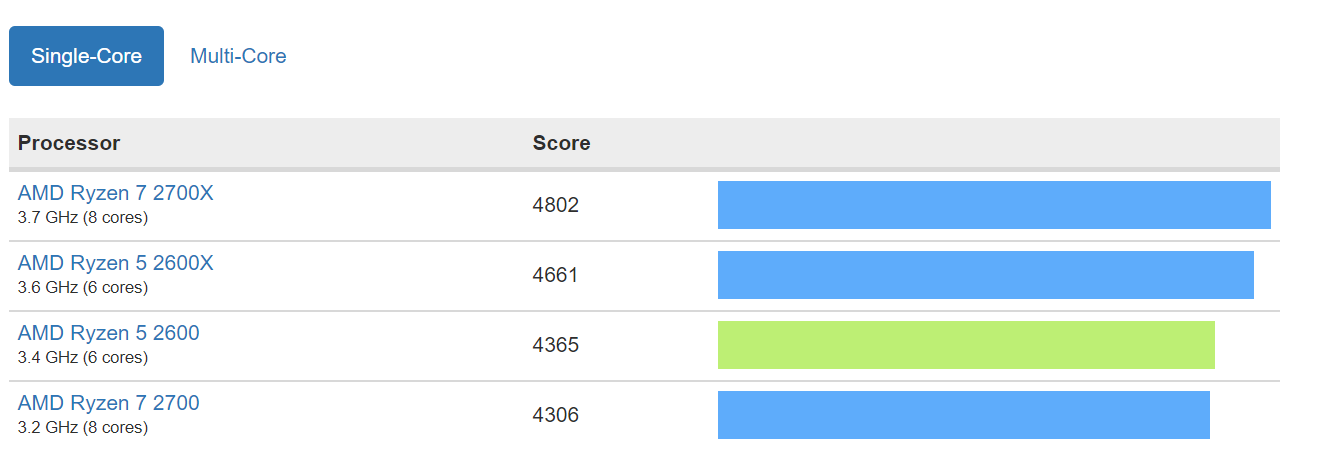
I will address the 3800X and 3700X as being the successors of the 2700X and 2700 respectively. In single-core performance, after applying a 23% boost, the 3800X will score a whopping 5906, which is getting dangerously close to the i9-9900K’s score of 6214. Next, the 3700X will score 5296, still faster than any Zen+ CPU but not near the i7-9700K’s 6022.
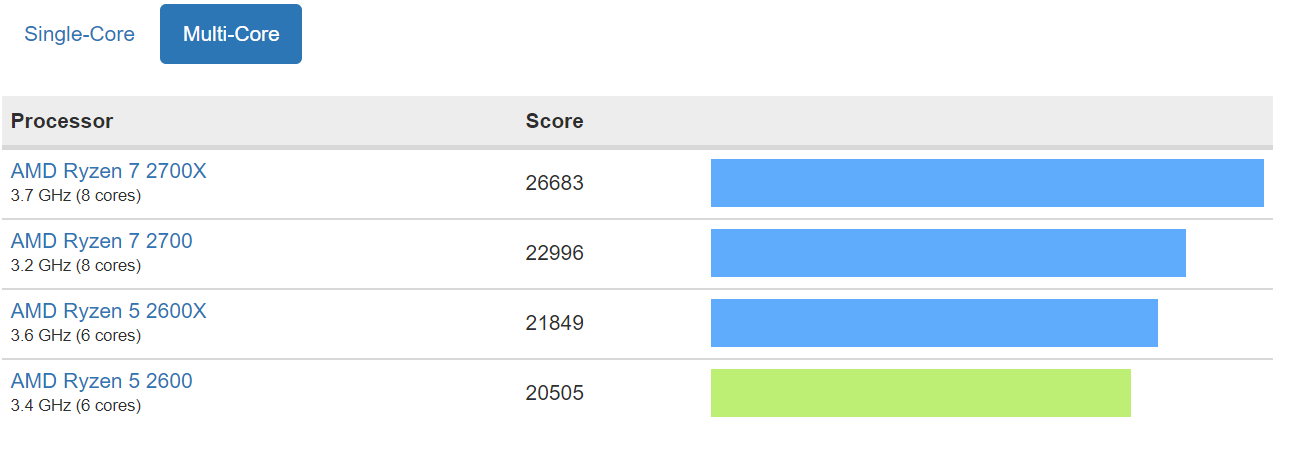
Now, onto multi-core performance, the 2700X with a 28% boost will score a blistering 34154, beating the i9-9900K’s 34003. The 3700X will score 29434 points, edging out the i7-9700K’s 28780. I will not try to find the performance of the Ryzen 9 3900X just yet because it is built differently compared to Threadripper CPUs and additional cores on Geekbench do not scale linearly. However, the main takeaway here is that although these scores are very rough, AMD’s Zen 2 CPUs will no doubt be extremely disruptive in terms of both price and performance.
 Marcus Tech Blog